Free Claude Code Plugin Marketplace: 12 Open Plugins, Added With One Line

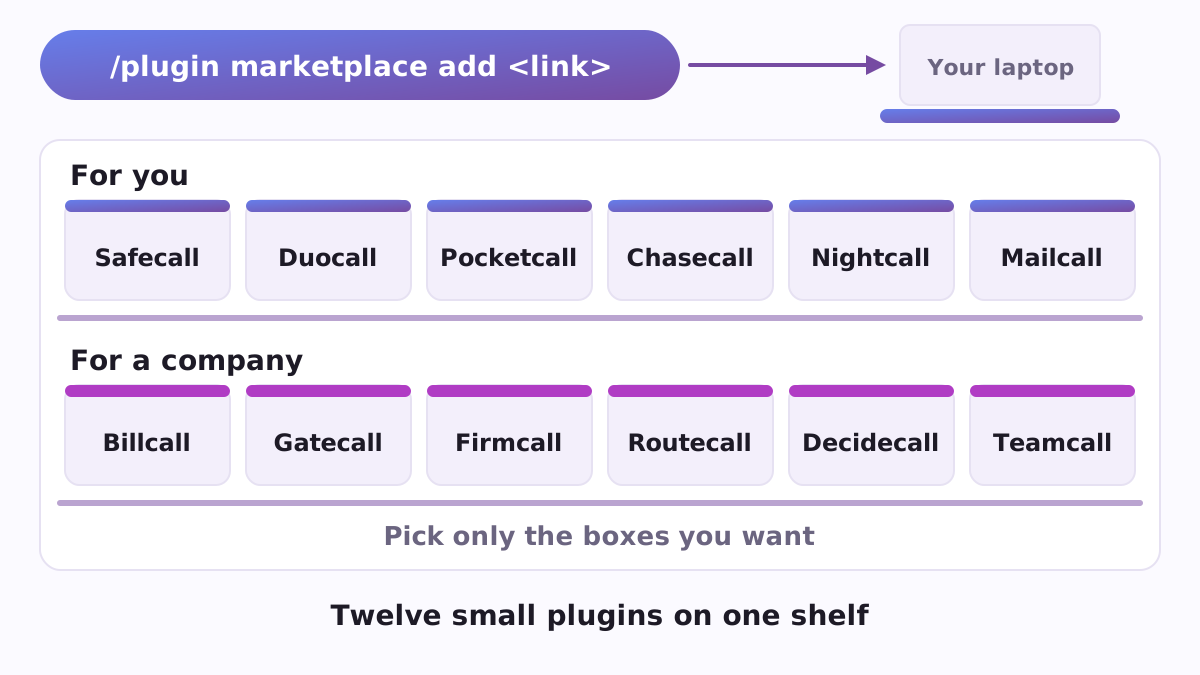
Claude Code is Anthropic's AI assistant that works with the files on your computer: it reads them, runs programs and does tasks for you. Out of the box it does a lot, and plugins let it do more: keep a copy of every file before it changes it, ask a different company's AI for a second opinion, chase someone who has not answered you, or tell a company what its AI really costs. Poly A1 plugins is a free, open-source shelf with twelve such additions on it. You add the shelf to Claude Code with one line, then take down only the boxes you want.
What a plugin is, and what a "marketplace" is
A plugin is a small add-on for Claude Code: a bundle of instructions and helper scripts that teaches it a new habit. A marketplace, also called a catalogue, is a list of plugins. It is one small file that says: here are the plugins, here is what each one does, here is where to download it. There are no accounts and no payments. Adding the marketplace shows you the list; you then install each plugin you want with one more line.
This repository is exactly that catalogue. Every plugin lives in its own public GitHub repository, and every release of a plugin carries one zip file. Each catalogue entry points to that released zip and pins it with a checksum (a fingerprint of the file), so what you download is byte for byte the file that was published, and a release never changes after it is out. Because the catalogue uses plain downloads, you need neither git nor a GitHub account. On 2 October 2026 it was checked live on a fresh Ubuntu 24.04 computer with no git, no unzip tool and no Python: the catalogue added, and the plugins installed and came up switched on.
What is on the shelf
Six plugins are for a person who is not a programmer:
- Safecall copies a file before anything is written to it, shows you the list of files before anything is read, and ends an answer by saying what nobody checked. It also has three ready ways of reading a document: where the catch is, what a plan is missing, and what is fact and what is opinion.
- Duocall asks a different company's AI for a second opinion and gives an exact account of where the two answers agree and differ, quoting both. It works through a free browser chat when no second program is installed.
- Pocketcall is for leaving the computer working and going out with your phone: it checks the seven quiet reasons an evening away usually fails, before you leave.
- Chasecall takes something nobody is answering, such as a refund or a booking. It keeps the task between sessions, writes the next letter, counts attempts and tells you when the call is yours to make.
- Nightcall keeps the computer awake for 8 or 12 hours on a Mac, Linux or Windows while Claude Code works through a plan. It keeps a progress file, checks its own work, brings in other AIs from your own subscriptions or free web chats (and replaces one that stops answering), and leaves a morning report of what was done.
- Mailcall reads your mailbox without changing it: a morning summary of what matters and who waits for your answer, and your Google Alerts and newsletters boiled down by the words you watch. It works through the Gmail connector of your Claude plan, or reads any mailbox with an app password kept in your computer's keychain. It writes drafts; you send them with one yes.
Six more are for a company that wants the strongest AI at the lowest monthly bill:
- Billcall: what AI costs, counted from one dated price table: the month of seats, API work and own machines, the price of one accepted task, the week's spend, budget alarms at 50, 80 and 100 per cent, and Team against Enterprise.
- Gatecall: what data may leave the company and where; its hooks (small checks that run before each step) stop keys, card numbers, IBANs, national ID numbers and lists of people, and red folders are read only by a model on the same computer.
- Firmcall: a plugin that writes the company's own plugin from an interview, plus the rules file for every laptop and the Jamf or Intune package that puts it there.
- Routecall: a strong model plans, cheaper and local models (DeepSeek, Kimi, Qwen, GLM, MiniMax, MiMo or one on your own machine) do the work, each in its own window, while the phone remote keeps working.
- Decidecall: repeated small decisions made cheaply, through a cache, rules, a small local model, a cheap cloud model, a strong model and a person, each only when the one before is not sure, with a test bench on the company's own examples.
- Teamcall: moving a company's people onto the agent in 30 days: a pilot charter, a 20-minute start for each person and a 5-hour path for a champion, one short card a day in Telegram or WhatsApp from the company's own bot, and a one-page "scale or stop" report.
The company plugins count, compare, write and decide on numbers that name their source and day; the person who holds the company's accounts then buys from the vendor's own page.
A concrete example
Say you want Claude Code to tidy a folder of old documents, and you would like a way back. Add the catalogue, install Safecall, and ask. Before a file is rewritten, a copy of it exists, so you can say "put it back the way it was". When the task ends, the answer includes a short note of what nobody checked. You did not write a single rule yourself.
How to start
In Claude Code, type these lines one at a time. The first adds the shelf, the others take down the boxes you choose:
/plugin marketplace add https://raw.githubusercontent.com/vadimchernets/poly-a1-plugins/main/.claude-plugin/marketplace.json
/plugin install safecall@poly-a1
/plugin install duocall@poly-a1
The catalogue needs Claude Code 2.1.224 or later (claude update brings it up to date). For any other plugin, swap in its name from the list above, written in lowercase: pocketcall, chasecall, nightcall, mailcall, billcall, gatecall, firmcall, routecall, decidecall or teamcall. Restart Claude Code, or type /reload-plugins, and the new plugin is on. If git is installed, the short form /plugin marketplace add vadimchernets/poly-a1-plugins works too.
One more step makes it keep itself current: in /plugin, open Marketplaces, choose poly-a1 and select Enable auto-update. Claude Code leaves this off for every marketplace other than Anthropic's own, and nothing inside a catalogue can switch it on, so this one click is yours. If you prefer the settings file, add "autoUpdate": true beside the source of the poly-a1 entry in ~/.claude/settings.json. After that, every fix made to the plugins reaches your computer by itself.
To move the catalogue to a new source later, change its source in place. Removing poly-a1 and adding it again uninstalls every plugin that came from it, together with its saved data.
On Windows, Mac and Linux
The plugins' hooks run on all three. On Windows they work whether Claude Code uses Git Bash or, on a computer without Git for Windows, PowerShell. The repository proves it on every change: an automatic test on GitHub's Windows, macOS and Linux machines installs Claude Code the way a person does, installs every plugin in the catalogue, runs every hook and every script the plugins' skills name, and then runs a real Claude Code session that fires them. A separate test starts from a Windows that has never had Python, installs Python in the middle, and checks that the plugins find it with no restart.
Good to know
The plugins need no account, no API key (a password-like code for paying a service per use) and no second subscription; they use the programs already installed and signed in on your machine. They need only Python 3.8 or newer, with no extra packages, and they speak five languages. On a computer without Python yet, Safecall and Chasecall say so in one line and start working the moment Python is there; on a Mac they never pop up Apple's install window in the middle of your work. Only Teamcall's daily cards go out to the network, and only to Telegram and WhatsApp. All twelve are open source under the Apache-2.0 licence, and the catalogue is archived on Zenodo (DOI 10.5281/zenodo.23107737).
The repository also holds a file, OFFER-THESE.md, that tells Claude Code itself when to suggest each plugin, so that it offers one at the moment it helps rather than a menu of twelve: Safecall before the first file of yours is changed, Duocall the first time an answer could cost money, health or a deadline, Nightcall when you say "let's finish tomorrow".
Poly A1 plugins is the computer part of Poly A1, which is now free to download. The phone part, where ChatGPT answers and Claude checks right on your phone, is Duo and Trio. Everything is at github.com/vadimchernets/poly-a1-plugins.
View poly-a1-plugins on GitHub
Vadym Chernets also builds Poly A1, an app in which AIs from different companies check each other's work.